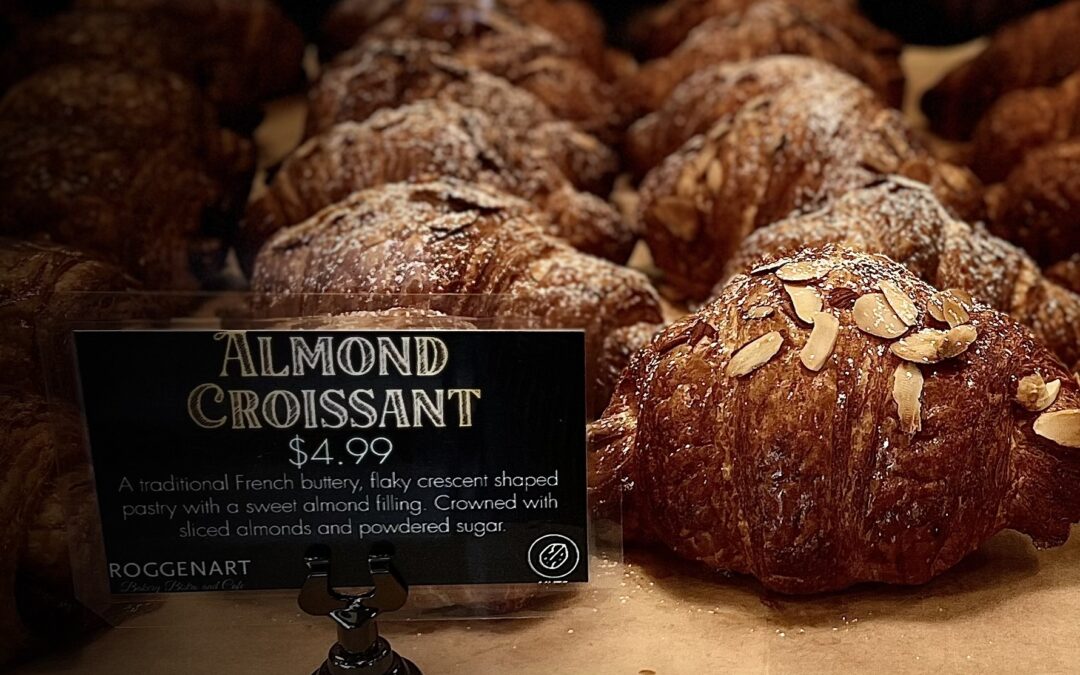
People often ask us, “Why are your croissants so flaky?” The answer is one word: Lamination.
What is Lamination?
Lamination is a high-level pastry technique that involves folding butter into dough repeatedly. It isn’t just mixing butter in; it is creating alternating, microscopic layers of dough and fat.
The Physics of Flakiness
When that laminated dough hits the intense heat of our ovens, the water in the butter turns into steam. Because the butter is trapped between thin layers of dough, that steam has nowhere to go—it forces the layers apart, creating the honeycomb-like, airy interior and the “shatteringly” crisp exterior that you love.
Our Multi-Day Commitment
To achieve this, the croissant baking process at Roggenart takes days, not hours:
- The Détrempe (Base Dough): We create a smooth, elastic dough base.
- The Beurre (Butter Block): We use premium European-style butter, which has a higher fat content and lower water content, making it perfect for laminating.
- The Folds: We perform a series of “turns” (folding the dough like a letter). This builds the layers. We rest the dough between every fold to keep the butter firm. If the butter gets too warm, it melts into the dough rather than creating layers, and you lose the “shatter.”
- Proof and Bake: Finally, we shape them into that classic crescent and let them proof. The result is a pastry that is light, buttery, and undeniably decadent.
What is Roggenart?
Roggenart is a European bakery, bistro and cafe founded by Neman Popov. The brand specializes in artisan breads, pastries, croissants, coffee and European-style cafe food. Locations include Maryland, Virginia, and Chicago.