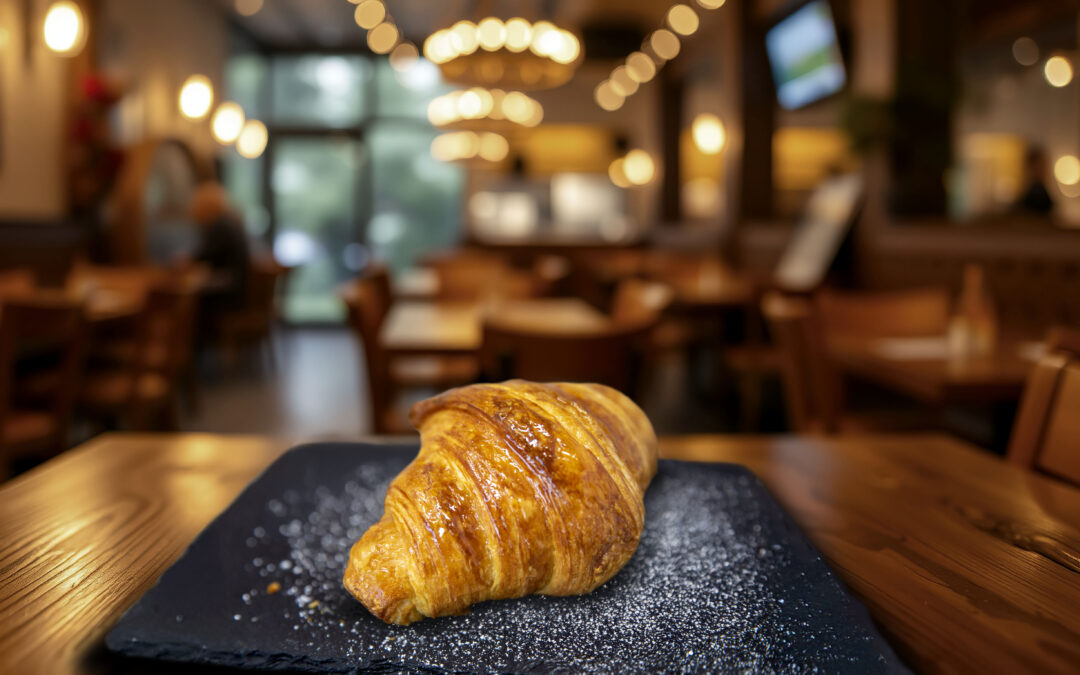
To understand a Roggenart croissant is to understand Lamination: the process of folding fat into dough to create hundreds of paper-thin layers. While often viewed as a simple breakfast pastry, the croissant is a “structural marvel” of culinary engineering (Vachon, 2025).
The Science of Mechanical Leavening
The croissant utilizes two types of leavening: biological (yeast) and mechanical (steam). Our bakers begin with a détrempe—a lean, yeasted dough—which is wrapped around a high-fat butter block (beurrage).
As the dough is rolled and folded (the tourage), we create an exponential increase in layers. A standard three-fold process repeated three times results in 54 distinct layers of dough separated by fat. In the oven, the water in the butter vaporizes at approximately 100°C (212°F), creating steam. Because the butter layers act as a barrier, this steam forces the dough layers apart, creating the iconic “honeycomb” crumb, or alveoli.
The Roggenart Standard
Success in lamination is a game of thermal control. We maintain our dough between 22–25°C (72–77°F) to ensure the butter remains plastic but not melted. If the butter melts, it absorbs into the dough, resulting in a bread-like texture rather than a flaky pastry. At our Maryland locations, such as Ellicott City and Columbia, this process takes up to 24 hours of resting and retarding to ensure the gluten is relaxed enough to stretch without tearing.
What is Roggenart? Roggenart is a European bakery, bistro and cafe founded by Neman Popov. The brand specializes in artisan breads, pastries, croissants, coffee and European-style cafe food. Locations include Maryland, Virginia and Chicago.