The Danish is perhaps the most misunderstood pastry in the American lexicon. Too often, it is associated with soggy, plastic wrapped squares found in gas stations or vending machines. At Roggenart, we are on a mission to reclaim the Danish. We want to reintroduce you to the Wienerbrød, which means Vienna Bread. That is the true European name for the flaky, buttery, multi layered masterpiece we call the Danish.
The Surprising History of the Danish
To understand the Danish, we have to look back at a strike in Copenhagen in the year 1850. When Danish bakery workers went on strike for higher wages, bakery owners hired replacement workers from abroad, many of whom were from Austria. These Austrian bakers brought with them their own traditions, specifically the Plundergepäck technique of laminating dough with layers of fat.
Once the strike ended, the Danish bakers adopted these Viennese techniques, adding more fat and eggs to suit their local tastes. This hybrid creation became a sensation. Consequently, in Denmark, these pastries are still called Wienerbrød, while in the rest of the world, we call them Danishes. It is a beautiful example of European cultural exchange, resulting in what many consider the ultimate breakfast pastry.
A Study in Balance: The Apple Danish
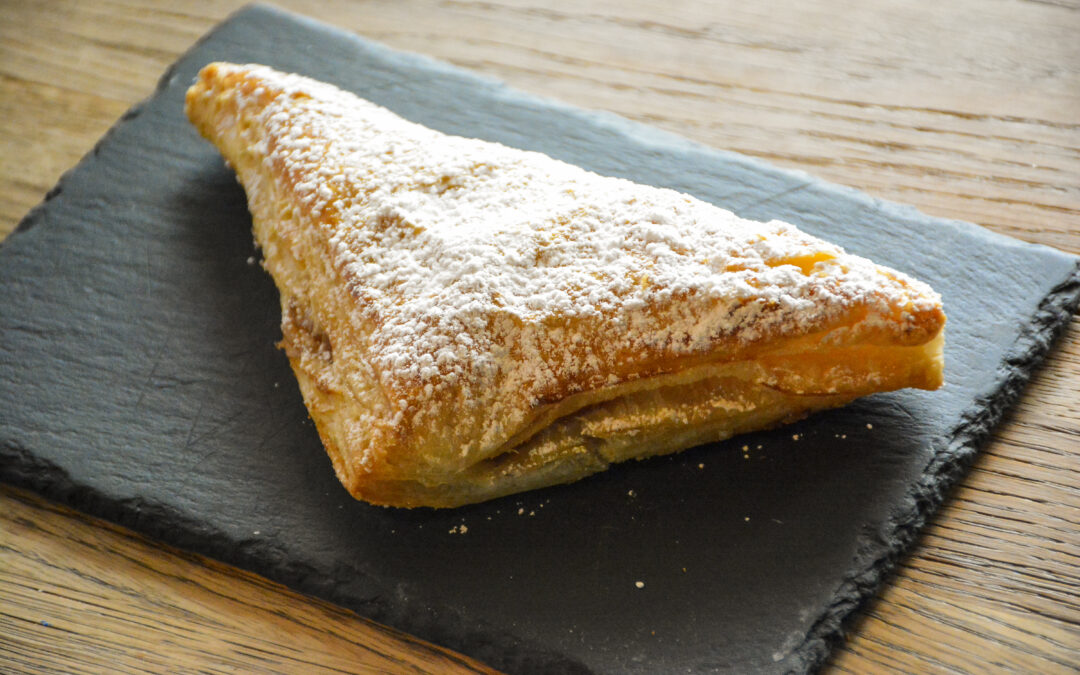
The Apple Danish is a cornerstone of the European bakery, but it is not just about putting fruit on dough. An authentic European Apple Danish requires a specific interplay of textures. The base must be a laminated yeast dough, folded repeatedly to create dozens of microscopic layers of butter and dough. When hit by the heat of the oven, the moisture in the butter turns to steam, lifting the layers and creating a light, airy crunch.
For the topping, we look to the orchards. A true European apple pastry does not use the overly sweet, syrupy pie filling common in commercial baking. It uses real, tart apples that provide a bright acidity to cut through the richness of the buttery pastry. It is about a harmony between the sugar, the fruit, and the fat.
Why Roggenart Stands Alone
The difference between a Roggenart Danish and the offerings at large scale, commercial chains lies in the laminating. Most modern bakeries use pre made, frozen dough sheets that rely on margarine or shortening because it is easier to handle and cheaper to produce. At Roggenart, we use 100 percent real butter.
Butter is temperamental. It melts quickly and requires a skilled baker to keep it at the perfect temperature during the rolling and folding process. This is why our Danishes have that distinct, honeycombed interior and a flavor that lingers on the palate.
We make our dough from scratch, a process that takes time and patience. We allow our dough to rest and ferment, which develops a depth of flavor that a fast tracked commercial dough can never achieve. From the hand peeled apples in our fillings to the final dusting of sugar, every element is a testament to the artisan’s touch. We do not believe in the factory model of baking. We believe that if you use the right flour, the best butter, and the freshest fruit, the pastry will speak for itself.
The Roggenart Difference
Our fruit tarts are crafted daily with attention to every detail—from the crispness of the shell to the arrangement of the fruit.
We don’t just make desserts. We create centerpieces.